
I look at Lévi-Strauss's kinship diagrams with an eye to what things they might encourage the reader to overlook.
content
Before continuing, you should know how to read Kinship Diagrams𓇯 like the following.
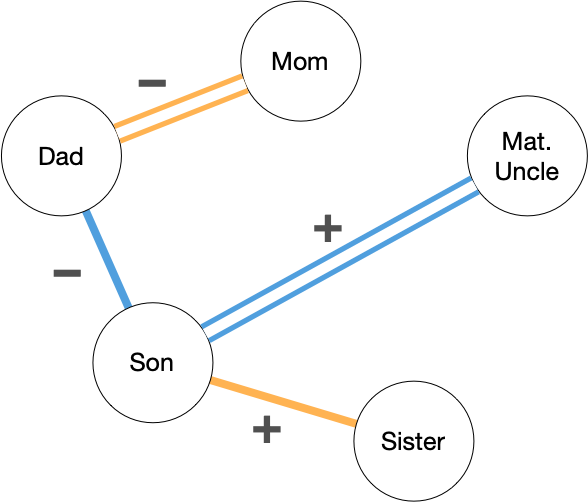
Relationships among family members
There are two really important facts that are omitted from this diagram:
* "Either warm or cold" is a really impoverished view of human relationships. Lévi-Strauss is scrupulous and points that out - in one sentence in the accompanying text. What else would he do? It's not conventional to repeat redundantly and repeatedly such warnings, but experience tells us people frequently skate right past them. This leads to the common situation where the simplification gets ignored in later work.
* Such diagrams are only relevant to that subset of societies where families are formed by one man giving a sister or a daughter to another man. In this particular case, it's unlikely that someone would think the regularity Lévi-Strauss observed would apply in, say, modern-day Germany. But over-extrapolating from diagrams is not uncommon, and warnings against such can only appear in accompanying text, which – experience tells us – is often forgotten.
I also note that Lévi-Strauss described this structure as the "atom" out of which whole kinship systems are built. "More research is needed." However, as far as I know, that was never followed up upon. I suspect there are lots of social dynamics behind that. Like: generating simple, powerful abstractions is higher status than putting such abstractions to the test. May be related to this advice to authors: Beware Building on the Aesthetically Appealing.
see also
I use funny little glyphs to hint at what a link links to.