
An explanation of Lévi-Strauss's kinship diagrams from _Structural Anthropology_.
content
Here is a kinship diagram:
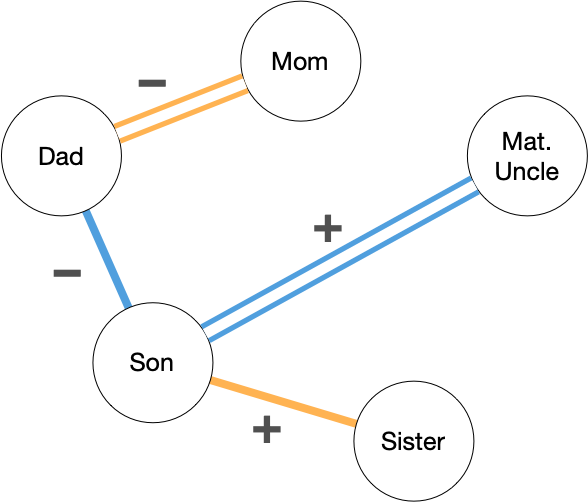
Relationships among family members
The nodes represent people: a father, his wife, their son, the son's sister (parents' daughter, but that's not relevant), and the children's maternal uncle.
The edges represent relationships, which may be either **warm** (**+**) or **cold** (**–**).
There are two colors of lines. Lévi-Strauss induced that there is a relationship between two lines of a single color in societies where marriage is organized around one man giving a sister or daughter to another. To wit: same-colored line must be of opposite signs (which is why I made the two lines of a particular color look different).
examples
In some societies, brothers and sisters are not allowed to sleep under the same roof. In such societies, mom and dad have a warm relationship.
Or, if the son and daughter are expected to sleep in the same bed, the culture might be one where the wife and husband only meet when the husband sneaks into her separate dwelling place for sex.
If the society is one where the father gives orders to the son and expects unquestioning obedience, it will be the maternal uncle who’ll spoil the son with gifts and sooth his hurt feelings. Or if the father is indulgent, the uncle must be a stern law-giver.
footnote
I'm drawing the diagrams differently than Lévi-Strauss did. His look like this:
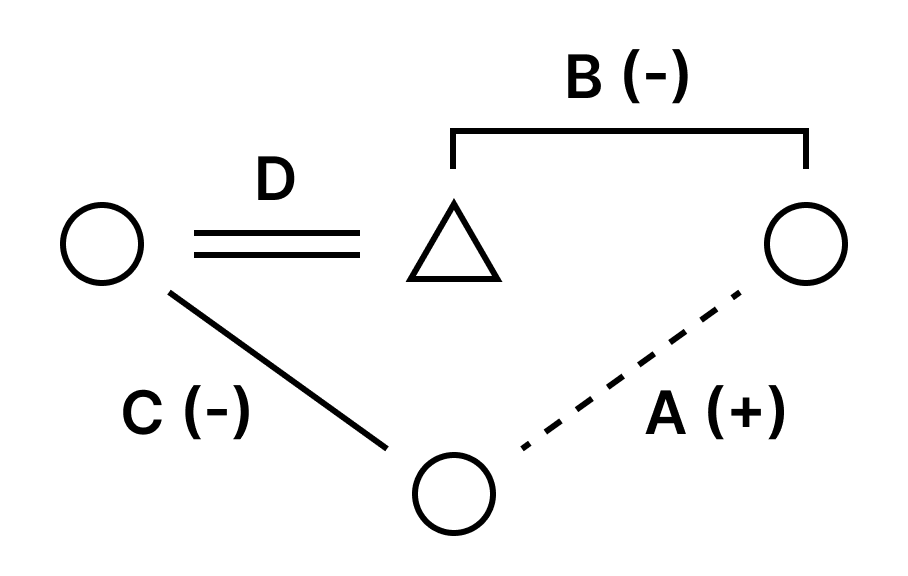
The original
I think the various symbols and such were conventional for anthropology, but we're not anthropologists now are we?