
Edges are probably the most important parts of a diagram. How to ask questions about what they're doing.
This page needs more work before it's ready for outside review.
context
I think most of the "oomph" from graphs comes from the edges. That's because diagrams are primarily about the relationships between things (of some sort). {{Four Principles of Structuralism}}.
This is sort of unfortunate, since edges look so innocent and anonymous. Typically, there are no words on them, so what they convey easily differs from what was meant.

Wildly informative
tips
**What *is* the relationship?**
It's often ambiguous. Or perhaps it's better to say that the *stated* meaning of the relationship is infected with semi-implicit connotations. Royce's Diagrams𓍯 make a good example:
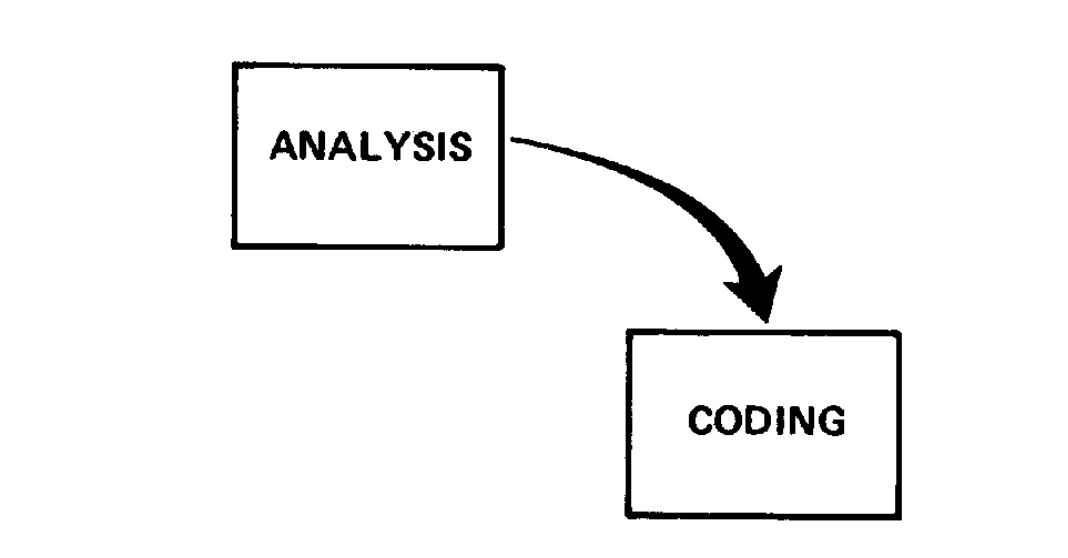
This is only sufficient for the simplest programs.
The primary meaning of the arrow is, I think, *logical dependence*. That is, the correctness of the coding depends on the correctness of the analysis.
However, a secondary meaning is *temporal order*. *First*, you do the analysis, *then* you do the coding. This pushes away the idea of
1. do some analysis 2. do some coding 3. goto 1
**Complexify the relationship**
Claude Lévi-Strauss's kinship diagrams feature **+/–** annotations to indicate whether a relationship is "warm" or "cold":
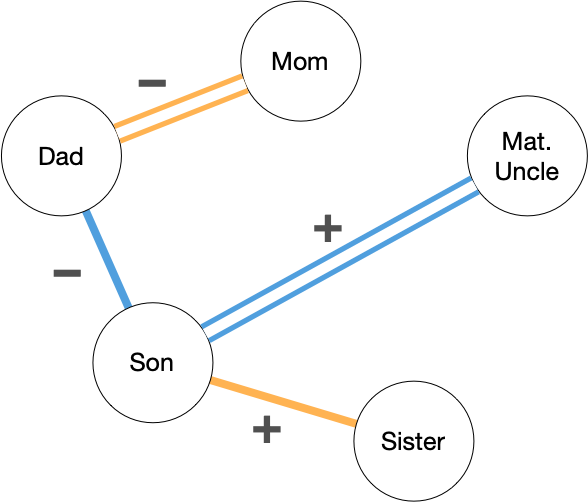
Lévi-Strauss's original diagrams look different, but the + and – annotations come from him.
It will be *very* easy for a reader to forget Lévi-Strauss's comment that that's a simplification. We humans do love our Binary Oppositions».
So make a special effort to ask "what about the relationship between the ends of the edges are obscured by the choice about how to label edges?" (Including no labels at all.)
**Reverse arrows**
Arrows almost always indicate a hierarchical relationship, with the source of the arrow higher status than the target. (Consider the `Analysis -> Coding` arrow above. Which do you think the author thinks is more important?)
The analysis technique of {{TBD: Deconstruction}} frequently begins by {{TBD: Inverting the Hierarchy}}, which means asking the question: what if the lower-status thing were actually *more* important than the higher-status thing?
So: if you had to draw an arrow from Coding to Analysis, what relationship would you be trying to think about / explain?